Connect with us

INTERNATIONAL

Muhammadu Buhari re-elected as Nigeria’s president

Published

on

Buhari

Nigeria’s electoral commission has declared incumbent Muhammadu Buhari the winner of the country’s presidential elections.

The announcement in the early hours of Wednesday means the 76-year-old has won a second four-year term at the helm of Africa’s largest economy and most populous country.

Hours after Buhari was declared the winner, opposition leader Atiku Abubakar rejected the results and vowed a legal challenge.

Buhari, of the ruling All Progressives Congress party, secured 56 per cent, or 15.2m votes, in the February 23 polls, Mahmood Yakubu, chairman of the Independent National Electoral Commission (INEC), said.

His main opponent, former vice president Abubakar of the People’s Democratic Party (PDP), received 41 per cent or 11.3m votes.

Hours after the announcement, Abubakar issued a statement rejecting the results.

“It is clear that there were manifest and premeditated malpractices in many states which negate the results announced…” he said.

“I hereby reject the result of the February 23, 2019, sham election and will be challenging it in court.”

The PDP has alleged electoral malpractice, including vote-rigging, in the polls, which were delayed by a week at the 11th hour.

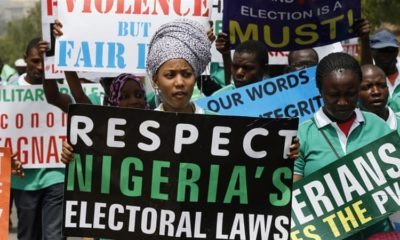
Voting was marked by hours-long delays and deadly violence that observers said kept some people away from the polls.

Buhari’s party has said the opposition was trying to discredit the returns from Saturday’s election.

The accusations have ratcheted up tensions in a country whose six decades of independence have been marked by long periods of military rule, coups and secessionist wars.

‘Marred by violence’

Observers from the Economic Community of the West African States, the African Union and the United Nations appealed to all parties to await the official results, expected later this week, before filing complaints.

The candidate with the most votes nationwide is declared the winner as long as they have at least one-quarter of the vote in two-thirds of Nigeria’s 36 states and the capital, Abuja. Otherwise, there is a second-round runoff.

Buhari, 76, secured enough votes to meet both requirements.

He took office in 2015 and sought a second term with pledges to fight corruption and overhaul Nigeria’s ailing road and rail network.

Atiku, 72, had said he would aim to double the size of the economy to $900bn by 2025, privatise the state oil company, and expand the role of the private sector.

Voting took place after a week-long delay which the election commission said was due to its inability to get ballots and results sheets to all parts of the country.

The vote – Africa’s largest democratic exercise – was also marred by violence with at least 47 people killed since Saturday, according to the Situation Room, a monitoring organisation linking various civil society groups.

Some deaths resulted from clashes between groups allied to the leading parties and the police over the theft of ballot boxes and allegations of vote fraud.

Police have not yet provided official casualty figures.

More than 260 people have been killed since the start of the election campaign in October.

The toll so far is lower than in earlier elections, but the worst violence occurred previously only after results were announced.
AL JAZEERA

Continue Reading
Advertisement
Click to comment

Leave a Reply

Your email address will not be published. Required fields are marked *

INTERNATIONAL

New UK ambassador Gill Lever presents credentials to Mnangagwa

Britain’s new ambassador to Zimbabwe says trade and investment, and opportunities for women and girls, are her priorities after meeting President Mnangagwa.

Published

on

Britain’s new ambassador to Zimbabwe, Gill Lever, presented her credentials to President Emmerson Mnangagwa on Thursday 15 October and set out the priorities she plans to pursue in Harare, according to reports by The Herald and New Zimbabwe.

Speaking after the meeting, Lever described the relationship between the two countries as a “modern respectful partnership”. She said she and the president had discussed bilateral relations, and that her priorities are trade and investment, opportunities for women and girls, and stronger people-to-people links between Britain and Zimbabwe.

Both outlets report that she pointed to a US$50 million financing deal announced last month through British International Investment, aimed at supporting farmers and entrepreneurs in Zimbabwe. The Herald reports that she also referred to investments intended to help address the country’s energy needs.

She also stressed stronger people-to-people links between the two countries. The reports do not say what specific measures that might involve, and neither carries a response from the Zimbabwean government beyond the meeting itself.

Her remarks, as quoted by both outlets, struck a cooperative tone focused on economic ties. The two reports spell her given names slightly differently, so this article uses the shorter form, Gill Lever.

Sources: The Herald, New Zimbabwe.

Continue Reading

DIASPORA

Zimbabwean lawyer Brian Kagoro blocked from Nairobi flight despite Kenyan court order

Brian Kagoro was pulled off an Addis Ababa flight to Nairobi and stopped from reboarding, months after a Kenyan court barred further arbitrary denial of his entry. Civil society groups are demanding answers.

Published

on

Zimbabwean constitutional lawyer Brian Kagoro was removed from a Nairobi-bound flight in Addis Ababa on Tuesday and prevented from reboarding, despite a Kenyan High Court order protecting his right to enter the country.

The Pan African Lawyers Union said Kagoro, 51, had boarded the flight when security personnel took him off the aircraft and questioned him. He was then barred from reboarding, making it impossible to complete the journey.

“The circumstances under which he was removed from the aircraft, questioned and prevented from continuing his journey are deeply concerning, particularly given the existing court order directing that he be granted entry into Kenya,” PALU said. It added that his legal team was seeking urgent clarification from the authorities and taking steps to enforce the order.

Kagoro, who is Africa Director at the Open Society Foundations and a co-founder of the Crisis in Zimbabwe Coalition, was detained for more than ten hours at Jomo Kenyatta International Airport on 22 February this year, declared persona non grata and flown back to Johannesburg. Kenyan officials accused him of involvement in a foreign-funded network seeking to coordinate anti-government protests. He denied the allegations, saying he had travelled for a family event and a speaking engagement.

PALU, the East Africa Law Society, the Law Society of Kenya and the Kenyan Section of the International Commission of Jurists filed a constitutional petition challenging the deportation on due process and rule-of-law grounds. In June the Constitutional and Human Rights Division of the High Court issued conservatory orders protecting Kagoro against further arbitrary denial of entry, pending determination of that petition. Tuesday’s trip was made under that order.

Kenyan civil society organisations had planned to receive him at the airport in a public show of solidarity, with a press briefing to follow. Both were cancelled.

More than 20 civil society organisations, professional associations and business figures have since demanded that the government comply with the order and account publicly for what happened, including whether Kenyan officials asked for or caused his removal in Addis Ababa.

“A court order binds every public officer and state agency. Immigration or national security powers cannot lawfully be used, directly or indirectly, to defeat it,” their statement said. They noted the incident fell on the International Day of Democracy.

Sources: Nairobi News; The Eastleigh Voice; Nehanda Radio; Kenyans.co.ke; statement by the Pan African Lawyers Union.

Continue Reading

INTERNATIONAL

Netherlands to close its Harare embassy in diplomatic network shake-up

The Dutch government will shut its Harare mission as part of a global restructuring, weeks after Sweden closed its own embassy in Zimbabwe. Dutch interests in Zimbabwe, Zambia and Malawi will be handled from elsewhere.

Published

on

The Netherlands is to close its embassy in Harare as part of a wider restructuring of its diplomatic network, the Dutch government has announced, in a decision that will also affect its work in Zambia and Malawi.

The closure was set out in a letter from Dutch Foreign Affairs Minister Tom Berendsen to the Netherlands House of Representatives, outlining plans to realign the country’s overseas mission network in response to what the government described as changing global dynamics.

“Our embassies are crucial in order to effectively promote the interests of our Kingdom. They are the eyes, ears and voice of the Netherlands abroad,” Berendsen said. “It is important for us to continually adapt the mission network with a view to geopolitical developments, and to make careful decisions on how and where Dutch interests will best be served.”

In a statement, the Netherlands Embassy in Zimbabwe acknowledged the decision would be significant news for partners and friends in Zimbabwe, Zambia and Malawi, given the relationships built up over the years.

“The decision is part of a broader restructuring of the Netherlands’ diplomatic network and does not change our appreciation for the close ties or our commitment to working with the respective governments and other partners across the region,” the embassy said, adding that it was focused on “ensuring a careful transition towards closure”.

The Dutch government also confirmed it would shut missions in Tripoli, Bujumbura and Yangon, along with its consulate-general in Rio de Janeiro. Dutch interests in the affected countries will in future be handled from embassies in neighbouring states. The government said it would explore opening embassies in Podgorica and Windhoek, working with Belgium and Luxembourg.

The announcement lands weeks after Sweden closed its own Harare embassy. The Swedish government confirmed that 31 August was the last day its Harare office was open to visitors, as it phased out bilateral development cooperation with Zimbabwe after decades of direct engagement, while saying diplomatic relations would continue with a sharper focus on trade and investment.

Sources: NewZimbabwe.com; NewsDay Zimbabwe; The Zimbabwean; Sweden Abroad (Embassy of Sweden, Harare).

Continue Reading

Trending